Supply chain roles have moved from the back office to the boardroom. Disruption, cost pressure and the push for resilience mean employers in Singapore are hiring supply chain talent at every level — from logistics coordinators and procurement executives to demand planners and supply chain managers. This guide covers the 50 questions that come up most often in Singapore interviews, with model answers grounded in the local trade environment.
How to Use This Guide
Questions are grouped by topic so you can target your weak areas. Read the model answer for the structure, then rewrite it in your own words with your own examples — interviewers can tell the difference immediately. Use the STAR method (Situation, Task, Action, Result) for every experience-based question, and always quantify the result.
What This Guide Covers
- Supply chain fundamentals and definitions (Q1–10)
- Demand planning, forecasting and S&OP (Q11–18)
- Procurement and supplier management (Q19–26) — expanded in our procurement interview questions guide
- Logistics, warehousing and Singapore trade compliance (Q27–35) — expanded in our logistics executive interview questions guide
- Inventory, cost and performance (Q36–43) — see the deep dives on inventory management techniques and supply chain KPIs
- Technology, data and behavioural questions (Q44–50)
Supply Chain Fundamentals (1–10)
1. Define supply chain management in your own words.
Supply chain management is the end-to-end planning and control of the flow of materials, information and money — from raw material sourcing through production, storage and distribution, to final delivery to the customer and any returns. The goal is to deliver the right product, in the right quantity, at the right place and time, at the lowest total cost.
2. What is the difference between logistics and supply chain management?
Logistics is a component of supply chain management. Logistics focuses on the physical movement and storage of goods — transport, warehousing, freight forwarding and last-mile delivery. Supply chain management is broader: it also covers demand planning, sourcing, supplier relationships, production planning, inventory strategy and information flows across all partners.
3. Walk me through the five key processes of a supply chain.
Using the SCOR model: Plan (forecast demand and balance it against supply), Source (select suppliers and purchase materials), Make (convert materials into finished goods), Deliver (warehouse, transport and fulfil orders), and Return (handle reverse logistics, defects and excess). A sixth process, Enable, covers the supporting data, systems, compliance and performance management.
4. What does upstream and downstream mean in a supply chain?
Upstream refers to everything on the supplier side — raw materials, components, inbound freight and the information flowing between you and your suppliers. Downstream refers to everything on the customer side — finished goods distribution, warehousing, transport and the final delivery to the end consumer. A strong candidate can give examples of managing both directions.
5. Why is Singapore considered a global supply chain hub?
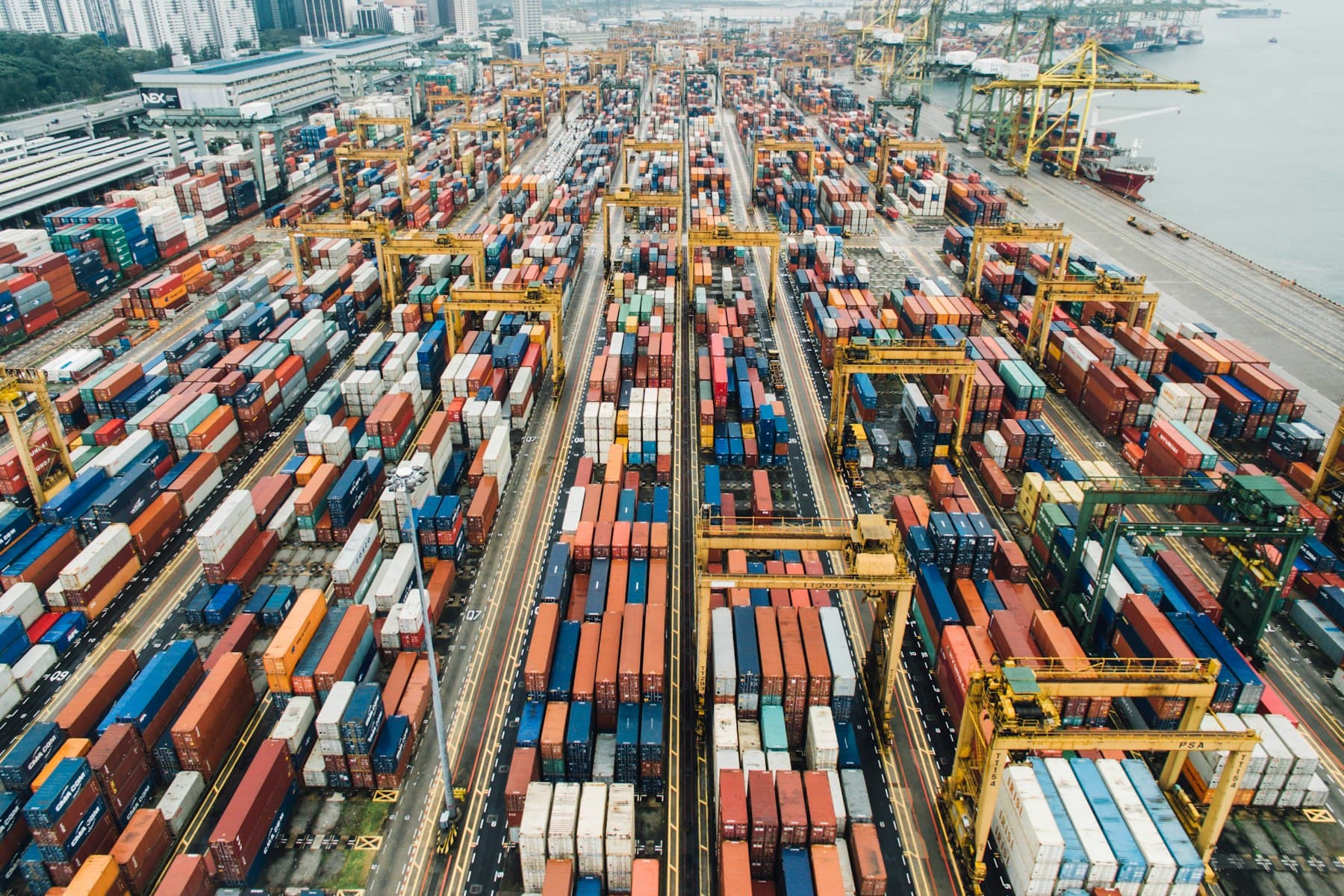
Singapore combines a world-leading container port operated by PSA, one of Asia's busiest air cargo hubs at Changi, and a highly digitised customs environment through TradeNet and the Networked Trade Platform. Add political stability, strong rule of law, an extensive network of free trade agreements and Free Trade Zones, and it becomes a natural regional distribution centre for companies serving Southeast Asia.
6. What is the bullwhip effect and how do you reduce it?
The bullwhip effect is the amplification of demand variability as you move upstream — a small change in end-customer demand causes progressively larger swings in orders at the distributor, manufacturer and raw material supplier. You reduce it by sharing point-of-sale demand data across partners, shortening lead times, reducing batch order sizes, stabilising pricing and promotions, and using collaborative planning and forecasting.
7. What is the difference between a push and a pull supply chain?
A push supply chain produces to forecast and pushes stock towards the customer — suitable for stable, high-volume, low-margin products. A pull supply chain produces in response to actual demand signals — suitable for variable or customised demand. Most real supply chains are hybrid, using a push-pull boundary or decoupling point where the strategy switches.
8. Explain the total cost of ownership concept.
Total cost of ownership looks beyond unit price to include freight, duties and GST, insurance, inspection, inventory holding cost, quality failure cost, payment terms, and end-of-life or disposal cost. A supplier with the lowest unit price often has the highest total cost once long lead times and quality issues are priced in. Framing decisions this way shows commercial maturity.
9. What are the main trade-offs a supply chain manager has to balance?
The classic trade-offs are cost versus service level, inventory versus availability, efficiency versus responsiveness, and centralisation versus local flexibility. There is no universally right answer — the correct balance is dictated by the company's competitive strategy. A cost-leader and a premium service brand should run structurally different supply chains.
10. What skills make someone successful in supply chain management?
Analytical ability and comfort with data, strong Excel and ERP skills, clear cross-functional communication, negotiation, problem-solving under time pressure, and commercial awareness of how supply chain decisions hit the P&L. Increasingly, familiarity with data visualisation and basic automation is expected even in executive-level roles.
Demand Planning, Forecasting & S&OP (11–18)
11. Why is demand forecasting important?
Forecasting drives almost every downstream decision: how much to buy, how much capacity to book, how much cash is tied up in stock, and what service level you can promise. A poor forecast shows up as either stockouts and lost sales, or excess and obsolete inventory. Forecasting is the input to budgeting, capacity planning and the S&OP process.
12. What forecasting methods do you know?
Qualitative methods include expert judgement, sales force estimates and market research — useful for new products with no history. Quantitative methods include moving average, weighted moving average, exponential smoothing, Holt-Winters for trend and seasonality, and regression against causal drivers such as promotions or weather. In practice a statistical baseline is generated and then enriched with commercial input.
13. How do you measure forecast accuracy?
The common measures are MAPE (Mean Absolute Percentage Error), MAD (Mean Absolute Deviation), and forecast bias, which shows whether you are consistently over- or under-forecasting. Bias matters as much as accuracy: a forecast that is consistently 10% high will quietly build excess inventory even if the error looks acceptable.
14. What is S&OP and why does the sequence matter?
Sales and Operations Planning is a monthly cross-functional cycle that aligns demand, supply, inventory and financial plans into one agreed number. The standard sequence is product review, demand review, supply review, pre-S&OP reconciliation, then the executive S&OP meeting. The sequence matters because each step needs the previous step's output — you cannot sensibly review supply capability before demand has been agreed.
15. What is the difference between S&OP and IBP?
Integrated Business Planning is the evolution of S&OP. S&OP typically focuses on balancing demand and supply volumes over an 18-month horizon. IBP extends the same cadence to a fuller business scope — including financial plans, new product pipelines, strategic initiatives and scenario planning — and is explicitly owned by the executive team rather than the supply chain function.
16. Explain MRP and what makes it work or fail.
Material Requirements Planning explodes the master production schedule through the bill of materials to calculate what to buy or make, in what quantity, and by when — netting off available inventory and open orders. MRP fails when the master data is wrong: inaccurate lead times, incorrect BOMs, stale safety stock settings or unreliable inventory records. Garbage in, garbage out is a genuine risk, not a cliché.
17. What is capacity planning and at what levels is it done?
Capacity planning determines the labour, equipment, storage and supplier capacity needed to meet forecast demand. It runs at several horizons: strategic capacity planning over years, rough-cut capacity planning at the master schedule level over months, and capacity requirements planning at the detailed scheduling level over weeks and days.
18. How do you handle conflicting objectives between sales, operations and finance?
I bring the conflict to a single set of numbers rather than debating opinions. Sales wants availability, operations wants stable long runs, finance wants low working capital — all three are legitimate. The S&OP forum exists precisely to make the trade-off visible and force a decision at the right level, with the cost and service consequences of each option quantified.
Procurement & Supplier Management (19–26)
19. Walk me through the strategic sourcing process.
Profile the spend category, analyse the supply market, define the sourcing strategy, run the supplier selection process through RFI and RFQ or RFP, negotiate and award, implement and transition, then continuously measure supplier performance. The final step is the one candidates most often forget, and it is where most of the value is either captured or lost.
20. How do you evaluate and approve a new supplier?
I assess financial stability, technical and production capability, quality systems and certifications, capacity headroom, lead time reliability, compliance and sustainability credentials, and cultural or communication fit. For critical items this includes a site audit and a sample or pilot order before full approval, plus a documented approved vendor list with review dates.
21. What is a make-or-buy decision and how do you approach it?
It is the decision on whether to produce in-house or outsource. I weigh total cost of ownership, whether the capability is strategically core, available internal capacity, quality control requirements, intellectual property risk, and supply market maturity. Something that is core to competitive differentiation is usually kept in-house even when outsourcing looks cheaper on paper.
22. What is the Kraljic matrix?
It segments purchases on two axes — profit impact and supply risk — into four quadrants: leverage items (high impact, low risk, use competitive tendering), strategic items (high impact, high risk, build partnerships), bottleneck items (low impact, high risk, secure supply continuity), and non-critical items (low impact, low risk, simplify and automate). It tells you where to spend your negotiation effort.
23. How do you build strong long-term supplier relationships?
Through open communication, honest forecasts, prompt payment, fair negotiation and joint problem-solving. Treating suppliers adversarially wins one negotiation and loses the next three. I share demand visibility so suppliers can plan, run regular business reviews against agreed KPIs, and involve strategic suppliers early in product and process changes.
24. How would you control or reduce procurement spend?
First get visibility through spend analysis by category, supplier and business unit. Then attack the levers in order: consolidate fragmented spend, eliminate maverick buying with proper channels, standardise specifications, re-tender leverage categories, renegotiate payment terms, and pursue demand management — the cheapest purchase is the one you avoid entirely.
25. What negotiation techniques do you use?
I prepare thoroughly: know the cost breakdown, the market benchmark, my BATNA and the supplier's likely position. In the negotiation I focus on expanding the value on the table — volume commitments, longer terms, payment terms, consignment stock, packaging — rather than only grinding on unit price, because price-only negotiation usually returns as a quality or service problem.
26. How do you handle a supplier that cannot deliver on time?
I establish the root cause and the realistic recovery date, then quantify the impact on production and customers. In parallel I work the mitigations: partial shipments, air freight upgrade, an approved alternate supplier, reallocating existing stock, or resequencing the production plan. Then I communicate early and clearly to internal stakeholders — surprises are far more damaging than bad news delivered on time.
Interviewing for a buyer or purchasing role? Work through our 40 procurement and purchasing interview questions for deeper coverage of tendering, contracts, negotiation and supplier risk.
Logistics, Warehousing & Trade Compliance (27–35)
27. What are Incoterms and why do they matter?
Incoterms 2020 are the eleven standard trade terms published by the ICC that define where risk and cost transfer between buyer and seller, and who arranges carriage, insurance and customs formalities. They matter because ambiguity over terms is a common source of unexpected cost and disputes — for example, agreeing DDP without understanding that the seller becomes responsible for import clearance and duties in the destination country.
28. What is the difference between FOB and CIF?
Under FOB (Free On Board), the seller's responsibility ends once goods are loaded on the vessel at the port of shipment; the buyer arranges and pays for main carriage and insurance. Under CIF (Cost, Insurance and Freight), the seller pays for carriage and minimum insurance to the destination port, but risk still transfers to the buyer at loading — a nuance interviewers like to probe.
29. How do you decide between sea, air, rail and road freight?
I balance cost, transit time, value density and urgency. Air suits high-value, low-weight or time-critical goods; sea suits bulk, heavy and low-value goods; road serves regional and last-mile movements; rail serves long-haul continental lanes. The full comparison also includes inventory carrying cost in transit — slower modes tie up more working capital, which sometimes closes the apparent cost gap.
30. What is TradeNet and how is it used in Singapore?
TradeNet is Singapore's national single-window electronic system for submitting import, export and transhipment permit declarations to Singapore Customs and the relevant controlling agencies. Declarations are submitted electronically and approved permits are returned quickly, which is central to Singapore's fast clearance times. The Networked Trade Platform sits alongside it as a wider digital trade ecosystem.
31. Explain Free Trade Zones and the Zero-GST Warehouse Scheme.
Free Trade Zones are designated areas where dutiable and taxable goods can be stored, repacked and transhipped without duty or GST being levied until they enter the domestic market. The Zero-GST Warehouse Scheme extends similar treatment to approved warehouses outside FTZs for non-dutiable goods, suspending import GST while the goods remain in the warehouse. Both are working capital tools as much as compliance mechanisms.
32. What is the difference between a 3PL and a 4PL?
A third-party logistics provider executes logistics activities — warehousing, transport, freight forwarding, customs brokerage — on your behalf. A fourth-party logistics provider acts as an integrator, managing multiple 3PLs and the wider supply chain design on the client's behalf, typically without owning the physical assets. A 4PL is chosen for orchestration and neutrality; a 3PL for execution.
33. What are the key layout and process principles in a warehouse?
Design flow to minimise travel distance, slot fast-moving SKUs closest to dispatch using velocity or ABC analysis, separate inbound and outbound where possible to avoid congestion, and design picking paths to reduce touches. Layer in accuracy controls — scanning at every touch, cycle counting, and clear location addressing — because picking accuracy usually costs more than picking speed when it fails.
34. How do you manage cold chain or temperature-sensitive goods?
Through validated temperature ranges at every stage, continuous data logging with alarms, qualified equipment and vehicles, trained handlers, defined excursion procedures, and full documentation for audit. In Singapore this is especially relevant for pharmaceuticals and food, where the regulator expects documented cold chain integrity, not just a claim of it.
35. What is reverse logistics and why is it becoming more important?
Reverse logistics covers the flow of goods back from the customer — returns, repairs, recalls, recycling and disposal. It matters increasingly because e-commerce return rates are high, because sustainability regulation is pushing producer responsibility, and because recovered value from returns and refurbishment goes straight to margin if the process is efficient.
Going for a logistics or freight role? Our 40 logistics executive interview questions cover all eleven Incoterms 2020 rules, TradeNet declarations, freight documentation and warehouse operations in detail.
Inventory, Cost & Performance Management (36–43)
36. How do you set safety stock levels?
Safety stock buffers variability in demand and in supply lead time. A standard statistical approach multiplies a service factor (the Z-score for the target service level) by the standard deviation of demand over the lead time. It should be reviewed regularly, because safety stock calculated on last year's variability quietly becomes either a stockout risk or dead capital.
37. Explain the difference between JIT and JIC inventory strategies.
Just-in-Time minimises holding cost by receiving materials only as needed, which requires reliable suppliers, short lead times and accurate forecasts. Just-in-Case holds buffer stock to protect against demand spikes and supply disruption. Post-pandemic, many companies have shifted towards a hybrid — JIT for stable, low-risk items and JIC for critical or single-sourced items.
38. What is ABC analysis and how do you use it?
ABC analysis segments SKUs by annual consumption value: roughly the top 20% of items (A) drive around 80% of value, while C items are numerous but low value. You then apply differentiated control — tight review cycles, accurate forecasting and low safety stock for A items, and simple reorder rules with larger buffers for C items, because the cost of managing them closely exceeds the benefit.
39. How do you identify and deal with excess and obsolete stock?
I flag items by coverage — months of stock on hand versus forward demand — and by last movement date, then classify them as slow-moving, non-moving or obsolete against a defined policy. Disposition options run from promotional discounting and reallocation to another market, to returning to supplier, reworking, or writing off. The more valuable exercise is root-cause analysis so the same excess is not rebuilt next quarter.
40. Which supply chain KPIs would you monitor?
At minimum: OTIF or on-time in-full delivery, order fill rate, perfect order rate, inventory turns and days of inventory outstanding, forecast accuracy and bias, supplier on-time delivery, cash-to-cash cycle time, and total logistics cost as a percentage of revenue. The right set depends on strategy — a service-driven business and a cost-driven business should not have identical scorecards.
41. What is the cash-to-cash cycle and why do finance teams care?
Cash-to-cash cycle time is days inventory outstanding plus days sales outstanding minus days payable outstanding. It measures how long cash is tied up between paying suppliers and collecting from customers. Finance cares because every day removed releases working capital — which is why inventory decisions are a treasury issue, not only an operations issue.
42. How do your finance colleagues influence your decisions?
Heavily, and productively. Finance sets the working capital targets that constrain inventory, validates the savings I claim from sourcing projects, and provides the cost data behind make-or-buy and freight mode decisions. I treat the finance business partner as a key stakeholder and agree the measurement basis for savings before a project starts, not after.
43. How would you improve the efficiency of a supply chain process?
I map the current process end to end, measure the baseline, identify where time, cost or errors accumulate, and address root causes rather than symptoms. In one order fulfilment process, manual data entry was causing errors and a five-day dispatch lead time; integrating order capture with the warehouse system removed the rekeying step and cut dispatch to under three days while reducing error-driven returns.
Expect to be asked for formulas. Interviewers frequently ask candidates to define a metric on the spot. Memorise the definitions in our supply chain KPI guide and the calculations in inventory management techniques explained.
Technology, Data & Behavioural Questions (44–50)
44. How proficient are you in Excel, and what do you use it for?
Excel remains the working tool of the supply chain analyst. I use pivot tables and Power Query for consolidating and cleaning data, XLOOKUP and INDEX-MATCH for joining datasets, SUMIFS and COUNTIFS for reporting, conditional formatting for exception highlighting, and Solver or scenario analysis for optimisation problems. I also build dashboards for stock coverage and supplier performance.
45. What ERP or WMS systems have you used?
Name the systems honestly and describe the modules you actually worked in — for example SAP MM and SD, Oracle, Microsoft Dynamics, or a WMS such as Manhattan or Blue Yonder. What interviewers really want is evidence that you understand the underlying process the system supports, because system-specific screens are quick to learn and process understanding is not.
46. How can data analytics improve supply chain performance?
Descriptive analytics gives visibility into what happened, diagnostic analytics explains why, predictive analytics forecasts demand and flags likely late shipments, and prescriptive analytics recommends the optimal inventory or routing decision. The practical starting point is usually clean, trusted master data — most analytics projects fail on data quality rather than on modelling.
47. What is your view on sustainability in supply chains?
It has moved from public relations to a commercial and regulatory requirement. Practical levers include route and load optimisation to cut emissions and cost simultaneously, packaging reduction, supplier codes of conduct with audit, circular flows for returns and refurbishment, and Scope 3 emissions measurement. The strongest answers show that sustainability and efficiency often point in the same direction.
48. How do you manage risk and disruption in a supply chain?
By mapping critical single points of failure, qualifying alternate suppliers for critical parts, holding strategic buffer stock where the cost of stockout is high, diversifying transport routes and modes, and maintaining a documented business continuity plan that is actually rehearsed. Risk management is judged in a crisis, so the preparation has to be done before one arrives.
49. Describe a time you collaborated across departments to deliver a result.
Use the STAR method. For a new product launch: the situation was a fixed launch date with an unproven demand forecast; the task was ensuring stock availability without over-committing capital; I worked with marketing on promotional plans, sales on customer commitments, and finance on the inventory budget, then built a phased build plan with a review gate after week two. The result was on-shelf availability at launch with no write-off of excess.
50. Where do you see supply chain management heading in the next five years?
Towards greater resilience and visibility — regionalised and dual sourcing rather than single-country dependency, real-time control-tower visibility across tiers, AI-assisted demand sensing and exception management, and mandatory sustainability reporting. For Singapore specifically, the role as a regional control tower and value-added distribution hub is likely to deepen even as physical volumes shift around the region.
Interview Tips for Supply Chain Roles in Singapore
Before the Interview
- Research the company's products, markets and sourcing footprint.
- Refresh the local essentials: Incoterms 2020, TradeNet, Free Trade Zones, GST on imports.
- Prepare three quantified achievement stories in STAR format.
- Review the systems named in the job advert — SAP, Oracle, Dynamics or a WMS.
During the Interview
- Use numbers — percentage cost reduction, days of lead time saved, service level achieved.
- Show you think in trade-offs, not absolutes: cost versus service, inventory versus availability.
- Demonstrate cross-functional awareness, especially with finance and sales.
- If you do not know a term, say so and explain how you would find out.
After the Interview
- Send a thank-you email within 24 hours referencing a specific point discussed.
- Follow up politely if the stated timeline passes with no response.
- Note the questions that caught you out and close those knowledge gaps before the next round.
Build Your Supply Chain Career with Edusphere
Interview confidence comes from genuine subject knowledge. A structured qualification in logistics and supply chain management gives you the vocabulary, frameworks and practical grounding that Singapore employers screen for — and a credential that gets your application read in the first place.
Popular logistics & supply chain courses at Edusphere